“Not Just Cute”: Japanese Culture Through Yoshitomo Nara’s Art
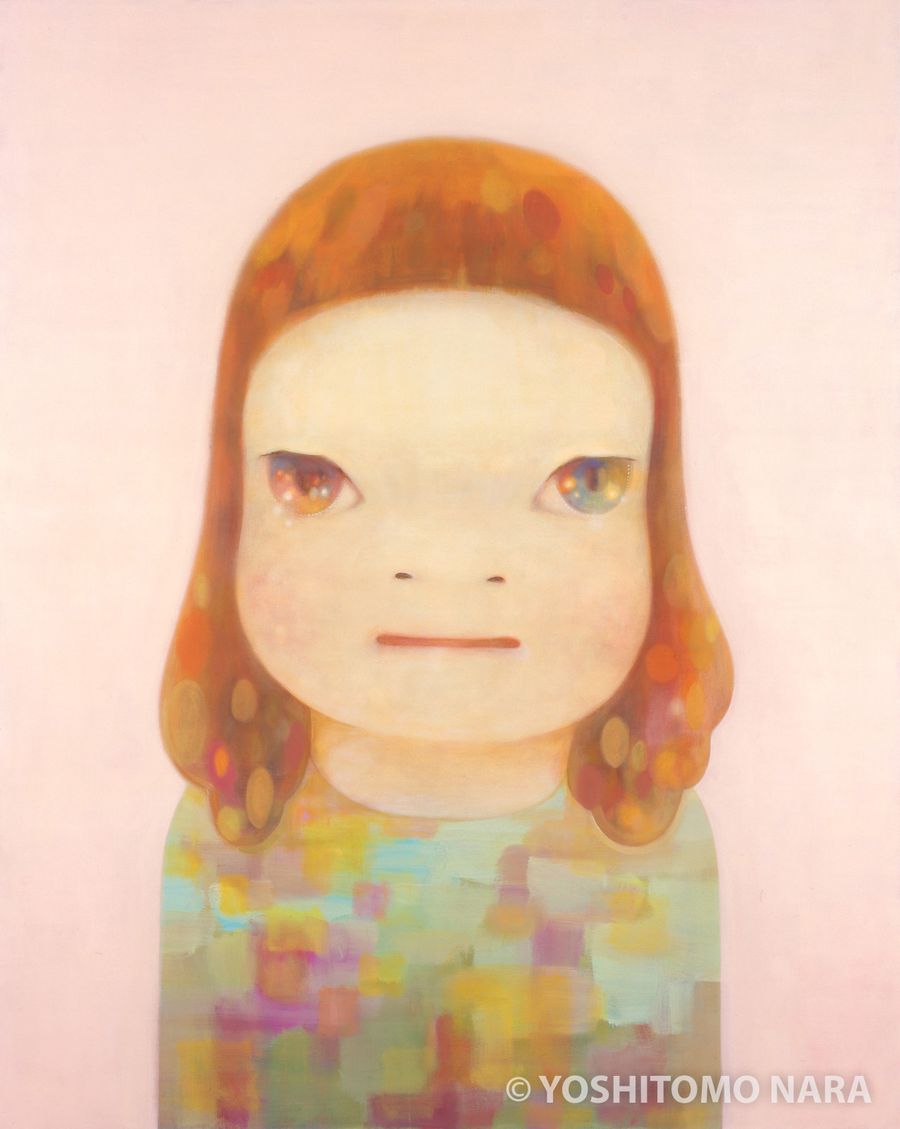
In Japanese anime and character culture, girls with large eyes are often portrayed as symbols of “cuteness.”
Yoshitomo Nara is a contemporary Japanese artist known for depicting girls with similarly large eyes, yet his works often leave viewers with a more complicated emotional impression. At first glance, his girls may look cute, but when you look at them more closely, you may begin to feel that something in their expressions is lonely, frustrated, or quietly angry.
Perhaps this is because unspoken emotions appear directly in their expressions. In Japanese culture, emotions are often expressed without being fully explained in words.
In this column, I would like to explore the connection between unspoken emotions and Japanese ways of expression through the works of Yoshitomo Nara.
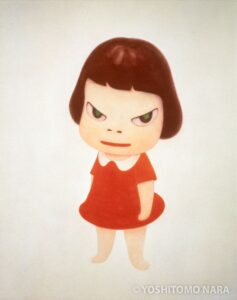
In many of Yoshitomo Nara’s works, children are depicted with large eyes and simple facial expressions. Although they appear cute, they often don’t smile and instead seem angry or lonely.
Because Nara does not fully explain the emotions in his works, different viewers may see different feelings in the girls’ expressions.
In this sense, his characters resemble the masks used in traditional Japanese Noh theater, whose expressions can look angry or sad depending on how the viewer feels. When emotions are left unexplained, viewers may begin to see their own memories and feelings in the girls’ expressions.
To me, this way of leaving emotions unspoken felt very Japanese.
The first time I encountered Yoshitomo Nara’s work was around 2000 at the Museum of Modern Art (MoMA) in New York. At first, I simply thought, “These are cute paintings of girls.” But as I continued looking into their eyes, a memory from my elementary school days suddenly came back to me.
At that time, I was struggling at a cram school where I could not fit in. One day, I gathered the courage to tell my mother that I did not want to go anymore. However, she dismissed my feelings and simply told me, “You must continue.”
Although I felt both anger and sadness, I could not express those emotions in words. I was just a child, and the world felt too big to fight back. Even now, I can still feel the heavy weight of that silence.
In some of Yoshitomo Nara’s works, girls are shown holding knives. Yet to me, those knives did not feel violent. Instead, they seemed like attempts to protect themselves while carrying emotions they could not put into words.
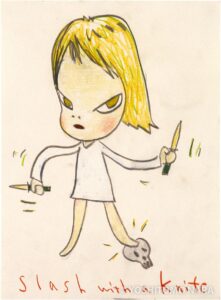
At that time, I could not express my feelings either and could only remain silent. That is why the knives seemed to me not like weapons meant to hurt others, but something meant to protect a hurt and frightened child.
For me, Yoshitomo Nara’s works were never simply “cute.”
His art quietly reminds us of emotions that we were never able to express in words.
If you ever encounter his work, I hope you will pause for a moment and look carefully into the girls’ eyes. You may find emotions there that you were never able to put into words yourself. Perhaps that is why people around the world continue to find parts of their own emotions in his works.

Yoshiko Niino is a midwife dedicated to improving Sexual and Reproductive Health and Rights (SRHR) throughout her career. After gaining clinical experience as a midwife, she lived in the United States for about seven years, where she gained intercultural experience and polished her English by taking a Master’s degree in Biomedical Ethics in English. She then returned to Japan and has since gained experience in administrative positions in the Ministry of Health, Labor and Welfare, and at an international health economics institution, during which she took a Ph.D. in medicine, followed by professor’s positions at undergraduate and master`s levels in nursing and midwifery. She now seeks to leverage these life experiences as a column writer in Tokyo.