A Moment with Irises: Discovering Rinpa at the Nezu Museum
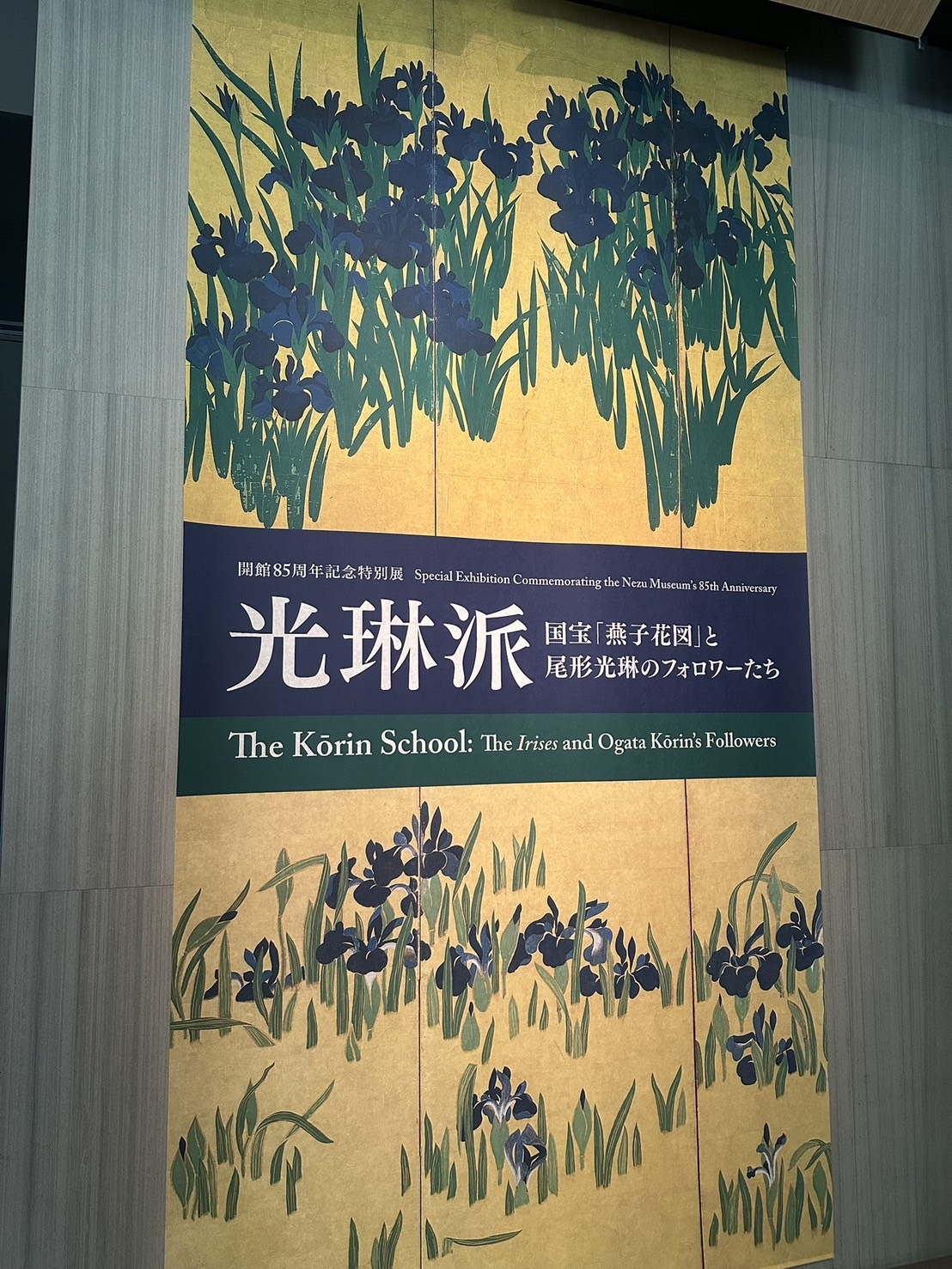
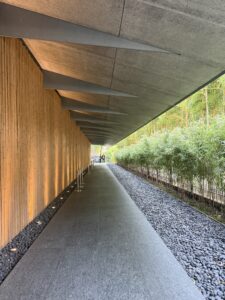
I recently visited the Nezu Museum in Tokyo, a place known not only for its elegant architecture and garden, but also for its carefully curated exhibitions. My visit happened to coincide with the seasonal display of a famous folding screen, Irises, a masterpiece of the Rinpa school. This exhibition is held only for a limited period each year, typically in late spring, when irises bloom in the museum’s garden. The timing creates a quiet but powerful connection between art and nature.
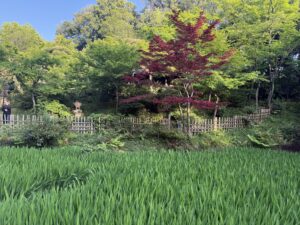
(Iris weren’t blooming yet…)
Standing in front of the golden folding screen, I was immediately struck by its boldness. The background is covered entirely in gold leaf, and across it, clusters of irises are arranged in a rhythmic pattern. At first glance, I thought I was looking at a painting. But as I spent more time with it, something began to shift in my understanding.
A painter friend of mine once told me that works like this should not be seen simply as paintings, but rather as designs. At the time, I didn’t fully understand what that meant. However, seeing this screen in person helped me grasp the idea more clearly.
Unlike Western paintings, which often aim to create depth and realism, this work does not try to reproduce nature as it appears. There is no perspective, no shading, and no attempt to show a realistic space. Instead, the irises are stylized, simplified, and repeated. Each flower is carefully placed, not to imitate reality, but to create balance and movement across the surface. In that sense, it feels closer to graphic design than to traditional painting.
This way of thinking reflects the essence of the Rinpa school, a distinctive style in Japanese art that developed during the Edo period. Artists like Ogata Kōrin valued pattern, rhythm, and decorative beauty over realism. Their works were often created not just as standalone paintings, but as part of everyday life—on folding screens, sliding doors, and objects used in living spaces.
Another interesting point I learned from my friend is how artists in the Rinpa tradition were trained. Unlike some Western approaches that emphasize individual expression from an early stage, Rinpa artists often began by copying the works of their predecessors. They would repeatedly study and reproduce established motifs—flowers, waves, seasonal elements—until they fully absorbed the style.
This process was not about simple imitation. Rather, it was a way to internalize a shared visual language. Once they mastered it, artists could then reinterpret these elements in their own way. In other words, creativity came after discipline, not before it.
Thinking about this changed how I viewed the screen in front of me. What I first saw as a beautiful image became something more layered—a composition built on tradition, repetition, and intentional design.
The experience also made me reflect on how we define art itself. We often separate art and design, or creativity and technique. But works like this remind us that these boundaries are not always clear. Beauty can come not only from originality, but also from refinement, repetition, and deep understanding of form.
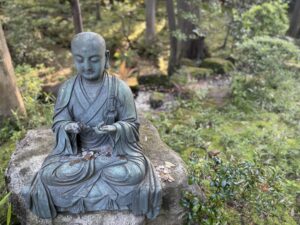
If you ever have the chance to visit the Nezu Museum during iris season, I highly recommend it. Not only can you see this iconic work up close, but you can also step outside and walk through a garden where real irises bloom quietly in the light. The experience of moving between art and nature, past and present, stays with you long after you leave.

English Teacher/ column writer
I am Ritsuko Shishido, an English teacher based in Japan. I studied abroad in Prince George, Canada from the age of 17 and later graduated from a Canadian university, where I studied ethnic conflict and learned the importance of seeing the world from multiple perspectives. Today, I train writers who share Japanese culture with the world in English. My mission is to help more people build meaningful connections across borders through language.