
Where the Real World Meets the Unseen: Fushimi Inari
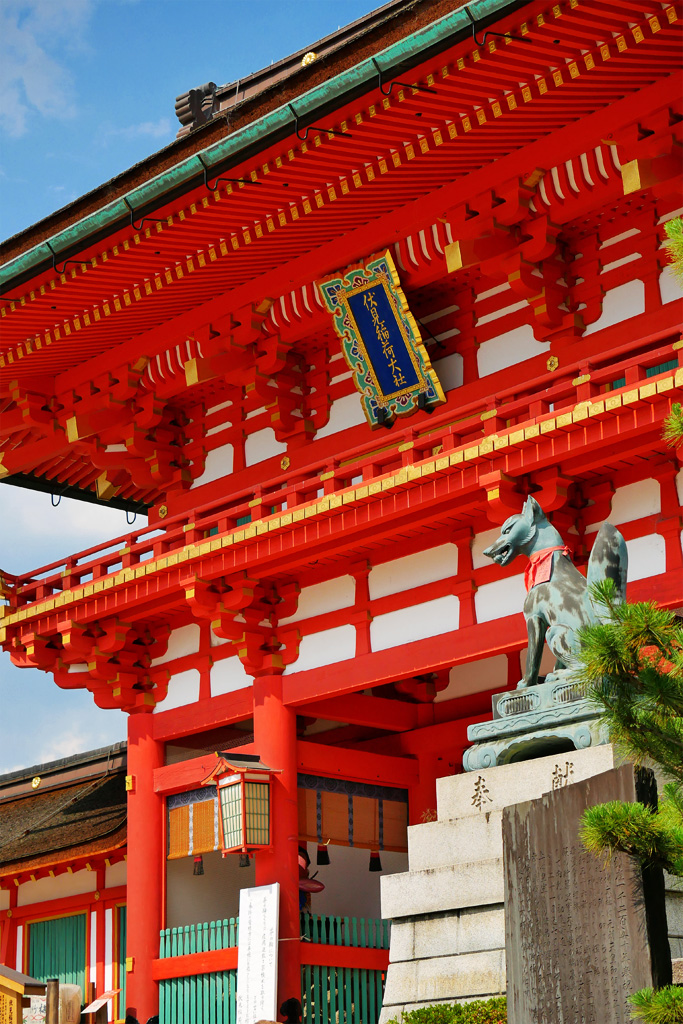
When you first saw strange creatures in Japanese anime, did you feel they were not just imaginary monsters? In Japan, these beings are often called yokai. Did you ever feel that they were scary, yet somehow familiar?
When I was a child, my first encounter with yokai in anime left a strong impression. They felt frightening, yet somehow nostalgic. This feeling may be connected to how Japanese culture views places that lie between the real world and the unseen.
In this column, I would like to share where this feeling comes from, based on my own experience.
In traditional Japanese belief, mountains were often seen as places where gods came down and dwelled. Mount Inari behind Fushimi Inari Taisha is one of these sacred mountains, and the mountain itself has long been worshipped.
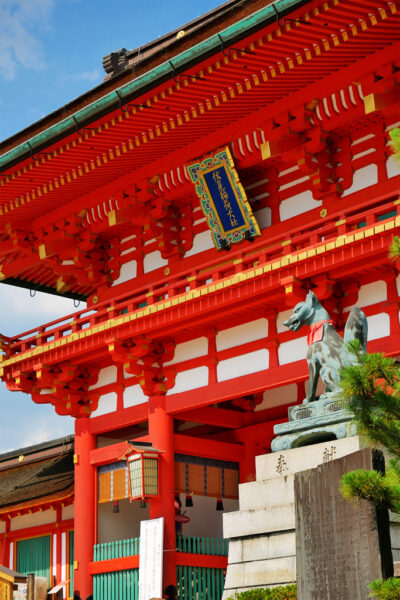
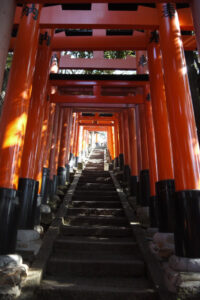
Fushimi Inari Taisha is seen as an entrance where people go to meet the gods. Rather than a shrine meant to be viewed from the outside, it is a place where worship begins by entering the mountain. At Fushimi Inari Taisha, visitors first encounter the famous torii gates. Passing through them marks the beginning of worship. Torii gates are often thought to mark the boundary between the human world and the realm of the gods. As you pass through the gates one by one, the space slowly begins to change.
You may find yourself in a place that is neither fully light nor fully dark. In the silence, you might start to sense a faint presence. At moments like this, you may feel that “something is there.” This vague, unsettling feeling may help explain why the idea of yokai developed in Japan.
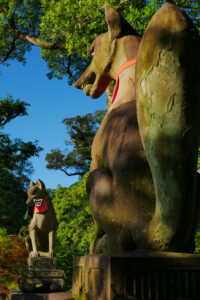
One September, I climbed the mountain route of Fushimi Inari Taisha with my friends.
As we walked deeper into the mountain, the world became very quiet. We were surrounded by many fox statues. Their eyes looked at us, but they also seemed to be looking at another world, giving me a strange, mysterious feeling.
The most striking moment was at sunset. The bright red of the torii gates faded into shadow. Suddenly, the path ahead looked exactly like the path behind. In that gray light—between day and night—the world felt different. Every sound, like our footsteps or the wind in the trees, became unnaturally loud.
At that moment, I realized I was standing on the “boundary” I had imagined. I felt a chill, as if someone was watching us. It was more than just an eerie story; I felt that “something was there.”
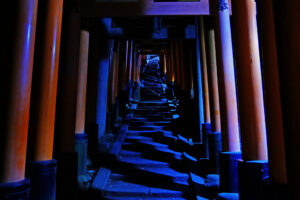
So, if you have the chance, try walking through Fushimi Inari Taisha both during the day and at night. Even along the same path, the world you experience can feel completely different. Through that difference, you may begin to understand why yokai feel less like stories and more like beings that exist close to the real world. That was the feeling I experienced there as well.
It may be one reason why people came to see foxes as yokai—beings that stand on the boundary between the human world and another world.